Votes, bills and records by issue · 119th Congress
Economics and Public Finance
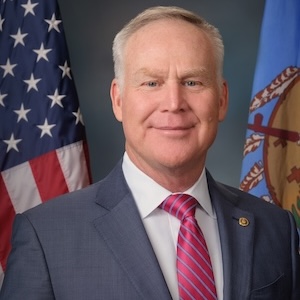
Alan Armstrong
Republican, Oklahoma
On Economics and Public Finance, their 20 votes sit level with the typical Republican.
Where this differs from their party: Close to the typical Republican. Voted with the Republican majority on 95.0% of 20 votes here, against 99.4% on all contested votes.
From votes
20 votes cast
Sits level with the typical Republican.
From bills backed
Too few bills for a position from bills: 1 measure counted, and a position needs 20.
Exact figures
Positions are coordinates on the map's main axis. Only the distance from the typical Democrat and typical Republican means anything.
From votes
- Senator at 0.38
- Democratic caucus median −0.42, from 47 senators
- Republican caucus median 0.38, from 54 senators
Each mark is a senator. The vertical line is the typical senator in that caucus.
A position shows which senators someone votes or legislates alongside, not whether they are for or against a policy. Issues come from each bill's topic, so an issue can include amendments on other topics. Left and right on the strips have no meaning of their own. Bills often have backers from both parties, so a position from bills is read against the medians for bills, not against the position from votes. See how these summaries are written.
- Contested vote:
- a roll call where the losing side got at least 10% of the votes cast.
- Party break:
- a contested vote against the majority of their own party.
- Cosponsor:
- a senator who signs on to support a measure, a bill or resolution, that another senator introduced. Bills backed means sponsored or cosponsored.
- Typical senator:
- the middle senator of a group, with half on each side. "17% of the way" means 17% of the distance from the typical senator in one party to the typical senator in the other.
- Votes with party
- 95.0%
- Votes against party
- 1
- Votes cast
- 20
One bill, S.Con.Res. 33, accounts for 17 of this senator's 20 votes on this issue.
Votes on this issue
To strike section 2019.
Voted Nay·Republican majority: Yea·Against the party majority
A concurrent resolution setting forth the congressional budget for the United States Government for fiscal year 2026 and setting forth the appropriate budgetary levels for fiscal years 2027 through 2035.
Voted Yea·Republican majority: Yea
To establish a deficit-neutral reserve fund relating to requiring the obligation of amounts appropriated to the Federal Emergency Management Agency to carry out the public assistance and hazard mitigation programs.
Voted Nay·Republican majority: Nay
To establish a deficit-neutral reserve fund relating to requiring the Comptroller General of the United States to conduct a study related to economic consequences of private or confidential drug pricing agreements struck by any Federal department, agency, or office with any…
Show the full description
pharmaceutical manufacturer.
Voted Nay·Republican majority: Nay
To create a point of order against reconciliation legislation that would provide funding to Federal agencies that have unobligated funds from previous reconciliation bills.
Voted Nay·Republican majority: Nay
To reduce the price of prescription drugs in the United States by more than 50 percent by adopting Most Favored Nation drug pricing so that the American people pay no more for prescription drugs than Europeans or Canadians.
Voted Nay·Republican majority: Nay
To establish a deficit-neutral reserve fund relating to the impacts of hedge fund ownership of single-family homes and rent prices.
Voted Nay·Republican majority: Nay
To reduce new budget authority for functions 150, 250, 500, and 600 in order to offset $70,000,000,000 of new spending by cutting $45,000,000,000 of foreign aid, eliminating $5,000,000,000 in refugee spending, cutting $16,000,000,000 from the Department of Education, and cutting…
Show the full description
$4,000,000,000 of National Science Foundation funding.
Voted Nay·Republican majority: Nay
To create a point of order against legislation that would not decrease home electricity bills.
Voted Nay·Republican majority: Nay
To establish a deficit-neutral reserve fund relating to extending the prohibition on Medicaid payments to abortion providers.
Voted Yea·Republican majority: Yea
To provide reconciliation instructions for the Committee on Rules and Administration and establish deficit-neutral reserve funds relating to establishing identification requirements for registration to vote in elections for Federal office, establishing photo identification…
Show the full description
requirements for voting in elections for Federal office, and election day and the counting of ballots in Federal elections.
Voted Yea·Republican majority: Yea
To establish a deficit-neutral reserve fund relating to increasing funding for child care for families.
Voted Nay·Republican majority: Nay
To establish a deficit-neutral reserve fund relating to ensuring that consumers are protected from price increases associated with tariffs and the Iran war.
Voted Nay·Republican majority: Nay
To create a point of order against reconciliation legislation that would not increase Federal funding for or participation in school meal programs.
Voted Nay·Republican majority: Nay
To create a point of order against reconciliation legislation fails to address the practice of insurance companies stepping between patients and their doctors to delay or deny access to care.
Voted Nay·Republican majority: Nay
To establish a deficit-neutral reserve fund relating to grocery costs.
Voted Nay·Republican majority: Nay
To create a point of order against reconciliation legislation that does not lower out-of-pocket health care costs while Americans struggle to make ends meet.
Voted Nay·Republican majority: Nay
A concurrent resolution setting forth the congressional budget for the United States Government for fiscal year 2026 and setting forth the appropriate budgetary levels for fiscal years 2027 through 2035.
Voted Yea·Republican majority: Yea
A bill making further consolidated appropriations for the fiscal year ending September 30, 2026, and for other purposes.
Voted Yea·Republican majority: Yea
A bill making further consolidated appropriations for the fiscal year ending September 30, 2026, and for other purposes.
Voted Yea·Republican majority: Yea
A vote against the party majority can reflect a home-state interest or a procedural step, such as a leader voting no in order to move to reconsider.
Legislation on this issue
These are records, not a score, and sponsoring a measure does not mean it moved. Simple and concurrent resolutions cannot become law, and a proposal enacted through a companion House bill or inside a larger bill is not counted as becoming law here.
Cosponsored
Prevent Government Shutdowns Act of 2026
Latest action, : Read the second time. Placed on Senate Legislative Calendar under General Orders. Calendar No. 424.